The Perch
Contents
Overview
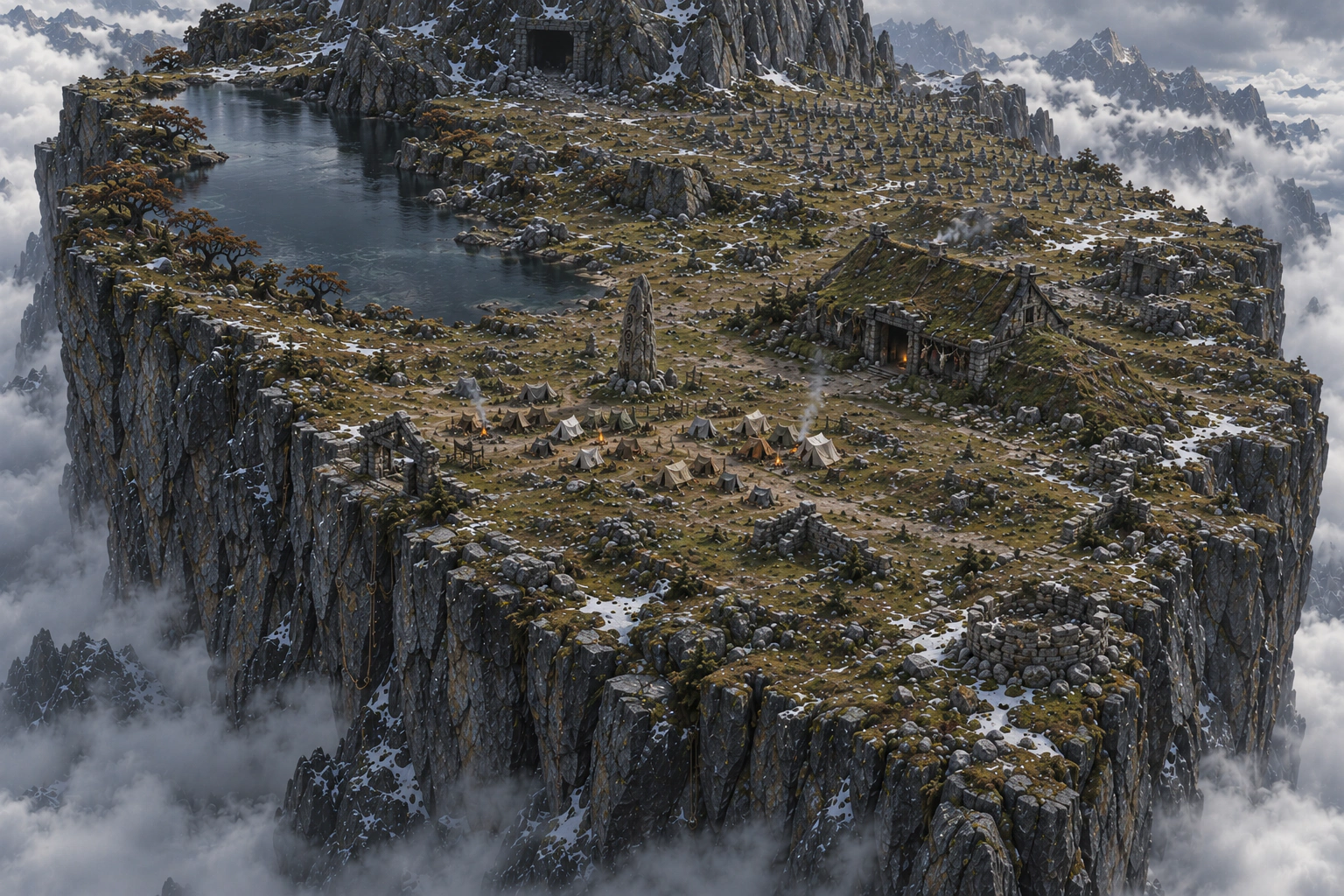
High on the Verdant Spine, above the cloud line, a shelf of open ground sits against the mountain with a sheer drop on every exposed side. There is no road to it, no stair, and no gate. A rope line hangs down the north face from iron anchors set into the rock, and anyone who wants to reach the Perch climbs it. The order considers this a feature.
Twice a year the Duskwalkers of Tinarywen gather here. Not the order entire, since the sea makes that impossible, but every walker who holds a reach on this continent and can make the climb. They stay a few days, argue, settle what needs settling, and go back down.
A dark meltwater tarn lies along one edge, running back behind the rock and out of sight, with a stand of wind twisted hawthorn along its near bank. The rest is uneven turf broken by outcrops and old snow. The camp pitches in the open middle, tents at whatever angle the ground allows, fires in shallow scrapes.
A lookout spur at the outer edge gives a view east across the whole country below: the river cutting through the hills, the pyroclastic flows laid out like spilt ink, Sylthilliel beyond, and on a clear day the far smudge of Vaeldor.
The Hall
One building on the shelf still stands. Long and low, massive undressed blocks, a turf roof weighted against the wind, a doorway with no door, and smoke from a hole at the ridge. Earth is banked up both long walls. Antlers, weathered skulls and bundles of dried herb hang under the eaves, and the lintel is covered in small shallow marks cut by generations of hands.
Inside is the only indoor space within a day’s climb, and the convocation is held in it.
The hall is built in the same style as the ruins around it and the dead city below.
Inside, there is a small infirmary, a meeting room, and a bookshelf. The bookshelf has many tomes, some new some old.
The ruins
Everything else that was ever built here has gone back to the ground. Low mossy swellings, broken lines of turf covered rubble, and two circular mounds of tumbled rock that were probably towers. Nothing stands above the knee, and most of it is ambiguous enough that you could walk over it without knowing.
At the back of the shelf a squared cave mouth of old masonry is cut into the rock, half blocked by fallen stone. It opens into an antechamber and then into the magma pipes, which carried rainwater down into the city long ago and now carry nothing.
The Cairns
Several hundred small stone piles in rough rows across the far end of the shelf. Walkers who die on the reach are rarely recovered, so they are remembered here instead. The newer cairns have names. The oldest do not.